We spent some of Boxing Day beekeeping. This might appear to be a surprising activity for Christmas time, but it was a cool sunny day and with the busy build up to Christmas passed, it allowed us the opportunity to treat the colonies for varroa with oxalic acid whilst they are brood-less and place some blocks of fondant across each cluster. In fact the colonies were quite active once the cover boards were off.
Having spent a few hours with our bees, it has spurred us on to muse on the year that was 2018.
Our first full year
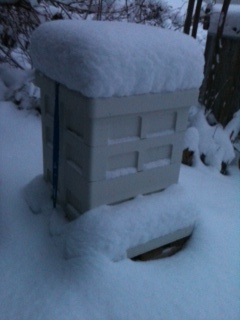
2018 provided us with our first opportunity to follow through the whole cycle of the beekeeping year. And what a year of extremes it was! The persistent cold and snow of March and April gave us a very late spring.
However, when it finally arrived much of the spring forage seemed to come and go in a flash. Then there was the long dry heat of June and July which was fabulous for queen rearing but also scorched and dessicated the ling heather to such an extent that much of it failed to flower at all in August on the hills around our apiary. Many other late summer flowers seemed to produce little nectar even when they did blossom so summer honey flows were limited and some of our new colonies required feeding in August.
What have we achieved?
At the end of our first full year, most importantly we are still beekeepers and still have bees!
Our primary aim this season was to increase our number of colonies as well as producing some honey. Split boards and the Demaree method of swarm control proved very useful techniques to achieve this. We were also helped by the warm dry June which allowed new queens to get mated in the shortest time possible. We had some laying only 12 days after emergence.
We have established a second apiary site. It is just 3 miles from the main apiary; close enough to be easily accessible but far enough away to prevent bees moved there from returning home after being split.
We have 5 colonies going into the winter: 3 hives, 2 nucs of our own as well as a nuc that we are fostering for Peeblesshire Beekeepers Association.
Our single production hive gave us a full super of honey, mainly from the earlier part of the season. The honey is very tasty — golden, floral and aromatic. But it is also very different to that from 2017 and lacks the strong ling heather after taste.
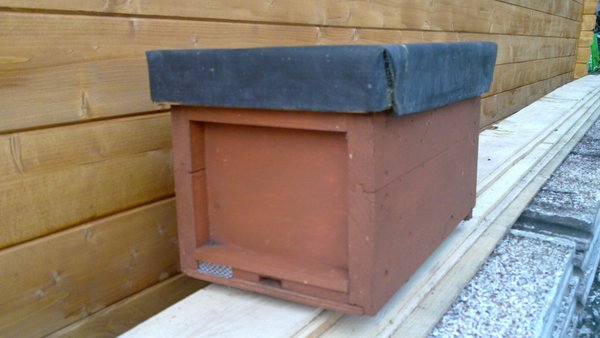
We built 2 mating Nucs based on Roger Patterson's plans that worked well and seemed popular with their residents.
We have used foundationless frames with bamboo skewer supports and tongue depressor starter strips for all our new frames this season. They seem to have worked well with the bees readily drawing out beautiful white comb quickly. We have seen no evidence of the over production of drone cells that some others have reported.
What could we have done better?
We still suffer from lack of drawn foundation and struggle to get the bees to draw it sufficiently in advance. This appears to be a constant problem for beginners.
Despite our best intentions at the beginning of the year, regular blogging here has been non-existent.
2019 and beyond
Looking ahead to 2019, we already have 3 new hives waiting to be painted to be ready to take the overwintered nucs. We have been looking to identify a temporary apiary site near the Heather that we could get permission to use.
We hope you have a very Happy Christmas and a wonderful New Year. Happy 2019!
